|
Among Wi-Fi 7 RF chipsets, Qualcomm’s QCN9274 and MediaTek’s MT7925 represent two distinct market directions: enterprise-grade high-performance infrastructure and mainstream consumer-grade connectivity. This article provides a comprehensive comparison covering specifications, performance, application scenarios, ecosystem compatibility, and deployment considerations to help users select the most suitable Wi-Fi 7 solution.
1. Product Positioning & Core SpecificationsQualcomm QCN9274Enterprise-Class High-Performance Wi-Fi 7 RF ChipThe QCN9274 belongs to Qualcomm’s Waikiki platform family and is designed for enterprise access points, industrial gateways, outdoor mesh systems, and carrier-grade wireless infrastructure. It is commonly paired with Qualcomm IPQ9574 or IPQ5424 network processors to deliver 10G-class wireless performance.
Key FeaturesQCN9274 is optimized for high-density, high-throughput networking environments requiring exceptional stability, ultra-low latency, and long-term reliability.
MediaTek MT7925Cost-Effective Mainstream Consumer Wi-Fi 7 ChipThe MediaTek MT7925 (Filogic 360 series) targets laptops, desktops, home routers, and smart devices. It focuses on affordability, low power consumption, broad compatibility, and easy deployment, making it one of the most widely adopted consumer Wi-Fi 7 solutions.
Key FeaturesMT7925 offers excellent price-to-performance ratio, lower power consumption, broad operating system compatibility, and simplified integration for consumer devices.
2. Performance ComparisonThroughput PerformanceQCN9274With its 4×4 MIMO architecture and enterprise-grade RF design, QCN9274 achieves exceptional wireless capacity. The 6GHz band alone can deliver up to 5.76Gbps throughput, making it ideal for:
MT7925 provides more than enough performance for mainstream consumer applications. Its 6GHz throughput can reach approximately 2.88Gbps, which is well suited for:
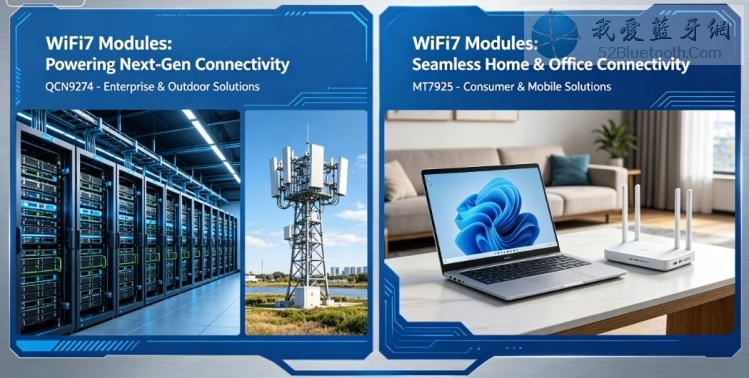
Designed for high-density deployments, QCN9274 supports up to 512 simultaneous clients, significantly reducing congestion and improving airtime efficiency in:
MT7925 supports around 128 concurrent devices, which is sufficient for:
Both chipsets support MLO technology, which reduces latency and improves connection reliability by aggregating multiple wireless links simultaneously.
QCN9274QCN9274 benefits from Qualcomm’s mature enterprise networking ecosystem, including:
It also integrates efficiently with Qualcomm network processors such as:
However, enterprise-grade hardware complexity and higher BOM costs make it more suitable for professional deployments.
MT7925 EcosystemMT7925 provides:
These advantages accelerate the adoption of Wi-Fi 7 in consumer and mainstream commercial markets.
5. Final Conclusion & Selection GuideChoose QCN9274 If You Need:QCN9274 and MT7925 target different segments of the Wi-Fi 7 ecosystem. QCN9274 focuses on enterprise and industrial-grade wireless infrastructure, while MT7925 emphasizes affordability and mass-market adoption.
There is no universally superior solution — only the most suitable chipset for the application scenario. Together, these two platforms are accelerating the global transition into the era of ultra-fast Wi-Fi 7 networking.
Optimized English Poster TextMAIN TITLEWi-Fi 7 Chipset Comparison
QCN9274 vs MT7925
Enterprise-Class Performance vs Consumer-Level Efficiency
QCN9274Powering the Next Generation of Ultra-Fast Wi-Fi 7 Connectivity
GMT+8, 2026-5-23 02:48 , Processed in 0.056522 second(s), 9 queries , Gzip On, MemCached On.
Powered by Discuz! X3.5
© 2001-2026 Discuz! Team.